
Self sabotage with food starts innocently enough. You finish eating lunch. Within minutes, that familiar voice begins: “I’m so bad with food. I have no self-control.”
Twenty minutes later, you’re standing in the kitchen at home or in the break room at work, eating something you told yourself you wouldn’t touch. Again.
“Why do I keep doing this?” you wonder. “Why do I self sabotage with food every single time I’m doing well?”
As a pharmacist in Cape Town who struggled with this exact pattern for years – and who’s observed this same cycle in countless patients – I can tell you something that changed everything for me: self sabotage with food isn’t about willpower, weakness, or lack of discipline.
It’s a predictable stress response to language that your brain interprets as a genuine threat. And once you understand the mechanism, everything becomes workable.
If you’ve read my posts on stress and blood sugar, you know that cortisol disrupts glucose control. Today, let me walk you through what likely happens in your body when shame triggers a stress response.
Important context: The timeline I’m about to describe is a simplified model based on what research tells us about stress physiology and shame responses. Think of this as a helpful way to understand the pattern, not a precise minute-by-minute medical map. Individual responses vary significantly, but understanding the general sequence helps you recognize what’s happening in your own body.
This isn’t the general stress response. This is what I call the shame cascade – and based on both research and my clinical observations, it appears to be faster, stronger, and more metabolically disruptive than everyday stress.
What Self Sabotage With Food Actually Is (And Isn’t)
Let’s start by clearing up what we’re really talking about.
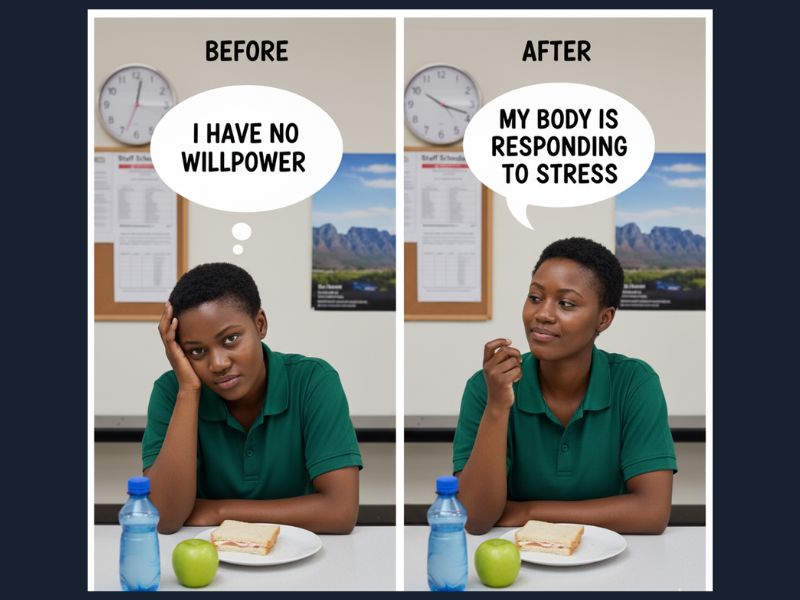
Self sabotage with food isn’t deliberate self-destruction – it’s your stress response hijacking your behavior. You’re not consciously choosing to fail. Your brain is unconsciously driving you toward food because it detected what it thinks is danger.
What’s actually happening is this: your brain is processing your self-criticism (“I’m so bad”) as a threat to your identity. In response, it activates your survival system. That system then drives you toward quick energy (food) because it genuinely believes you’re in danger.
Self sabotage with food is really self-criticism triggering a stress response that creates biochemical food urgency.
Here’s what it’s NOT:
- A character flaw or moral failing
- Proof that you’re “broken” or “beyond help”
- Evidence that you lack willpower or discipline
- Something only weak people experience
Here’s what it IS:
- A normal stress response to perceived identity threat
- A predictable biochemical cascade with measurable effects
- Something that happens to anyone who uses harsh self-talk
- Completely workable once you understand the mechanism
The Five Words That Rewire Your Metabolism
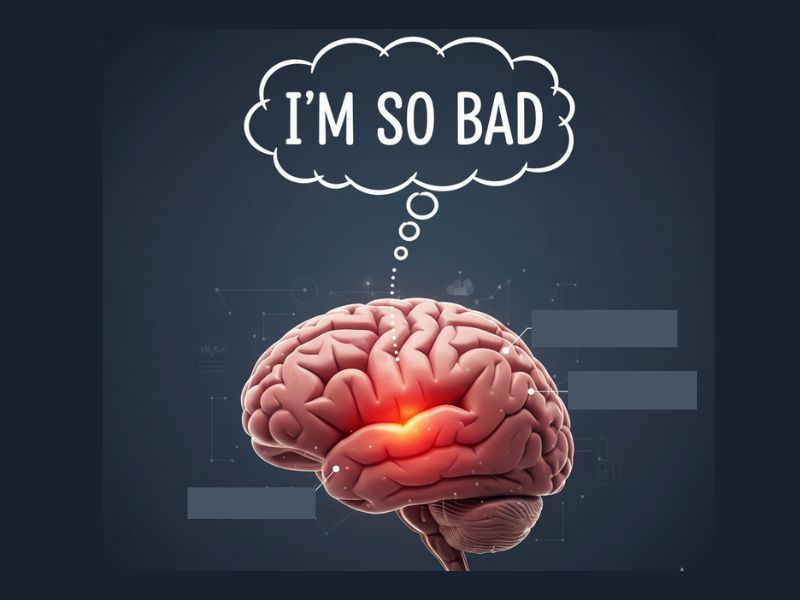
“I’m so bad with food.”
Five simple words. You’ve probably said them hundreds, maybe thousands of times. They feel like honest self-reflection, maybe even motivation to do better next time.
But here’s what most people don’t realize: your brain processes these words as a threat to your core identity. And it responds accordingly.
Research using brain imaging reveals something remarkable: shame activates the exact same neural regions as physical pain. Your amygdala – your brain’s alarm center – literally cannot distinguish between “I’m so bad with food” and “I’m being physically attacked.”
Both trigger immediate survival responses.
Think about that for a moment. When you say “I’m so bad,” you’re not just having a thought. You’re activating the same brain regions that fire when you stub your toe, burn your hand, or experience physical injury.
Your nervous system doesn’t interpret “I’m so bad with food” as gentle self-reflection. It registers it as a code red, identity-level threat.
Why “I’m So Bad” Creates Self Sabotage With Food
The key difference between general stress (like work pressure) and shame-based self-talk lies in what’s being threatened.
Work stress threatens your circumstances. Shame threatens your identity.
When you say “I did something bad,” your brain processes a behavior that can be corrected. However, when you say “I AM bad,” you’ve escalated to an identity-level threat. Your brain now believes that your fundamental worth as a person is under attack.
This triggers much deeper, more primitive survival mechanisms. Furthermore, it explains why shame-based self-talk creates such powerful food urgency – your body is trying to rescue you from what it perceives as existential danger.
The Biochemical Cascade: How Self Sabotage With Food Actually Happens
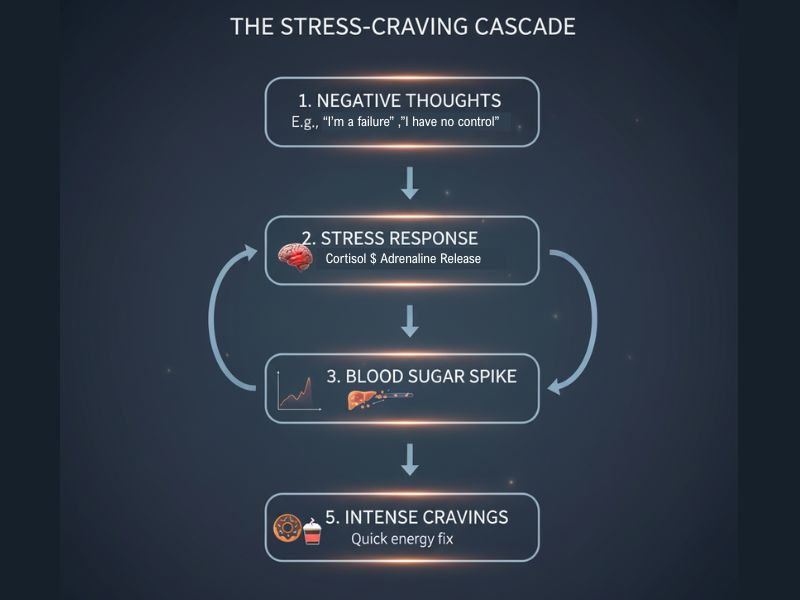
This isn’t the general stress response. This is the shame cascade – and it’s faster, stronger, and more metabolically disruptive than everyday stress.
Within Seconds: The Threat Detection Phase
The moment you think “I’m so bad with food,” several things happen simultaneously:
Your amygdala – the alarm center deep in your brain – detects what it interprets as an identity threat. Unlike the slower processing of everyday stressors, shame triggers immediate alarm activation.
Stress hormones begin flooding your system. Your hypothalamus activates your sympathetic nervous system (fight-or-flight mode). Meanwhile, your body starts preparing for emergency action.
Moreover, this happens before your rational thinking brain (prefrontal cortex) can intervene. The threat detection is automatic and instant.
Within the First Few Minutes: The Chemical Storm
Now the hormonal cascade intensifies rapidly.
Cortisol levels spike dramatically – higher and faster than general stress produces. Adrenaline increases your heart rate and blood pressure. Your liver, responding to what it believes is an emergency situation, dumps stored glucose into your bloodstream.
In addition, your insulin response becomes erratic and unpredictable. Your pancreas, confused by the sudden glucose flood during a non-eating situation, struggles to calibrate the right insulin release.
Here’s the crucial detail: shame also triggers inflammatory markers called cytokines. These compounds amplify the stress response and can persist for hours after the initial shame thought. This inflammatory component doesn’t happen with general stress – it’s specific to identity-threat responses like shame.
Within 2-10 Minutes: The Blood Sugar Chaos
Your blood sugar is now swinging wildly as your body tries to manage the glucose flood. As a result, your cells become temporarily insulin resistant – they literally stop responding properly to insulin signals.
At the same time, hunger hormones (ghrelin) increase dramatically. Meanwhile, satiety signals (leptin) become suppressed. Your body is essentially overriding its normal “I’m full” messages.
This explains why you can eat lunch, feel physically satisfied, then suddenly feel ravenously hungry after thinking “I’m so bad.” It’s not true hunger – it’s hormone chaos.
This hormone chaos often intensifies at specific times of day. If you find sugar cravings particularly strong at night, evening shame thoughts combined with cortisol disruption create the perfect storm for late-night eating.
After Several Minutes: The Craving Command

By now, your brain interprets the blood sugar instability as potential starvation. Urgent signals for quick energy – specifically sugar and refined carbohydrates – intensify throughout your system.
Your decision-making centers in your prefrontal cortex go partially offline. This is why “just don’t eat it” doesn’t work – the part of your brain responsible for rational decisions isn’t fully operational.
You feel compelled to eat, not because you’re weak or lack discipline, but because of biochemical drives. This is why you sabotage your diet – it’s not willpower failure, it’s a stress-induced metabolic state demanding quick fuel.
I’ve watched this play out countless times in Cape Town, both in my own life and observing others. Someone eats a healthy lunch at Woolworths, has a shame thought, then finds themselves back in the snack aisle twenty minutes later, genuinely confused about how they got there.
That’s not self sabotage with food in the traditional sense. That’s a hijacked nervous system following its survival programming.
A note about this timeline: The cascade I’ve described is a simplified model to help you understand the shame-stress-eating connection. Your individual response may be faster, slower, or different in sequence. Some people experience intense immediate cravings; others notice effects hours later. The value isn’t in memorizing exact timing – it’s in recognizing that your harsh self-talk triggers real physiological responses that create genuine food urgency. If you’re experiencing persistent metabolic issues or disordered eating patterns, consult your healthcare provider for proper evaluation.
The Shame Signatures Behind Self Sabotage With Food
After years of studying this pattern – both in research and through personal experience – I’ve identified something crucial: not all self-criticism creates the same physiological response.
Specific types of shame-based self-talk create predictable metabolic patterns. I call these “shame signatures.”
Understanding your personal shame signature helps you recognize what’s happening in your body and interrupt the pattern more effectively.
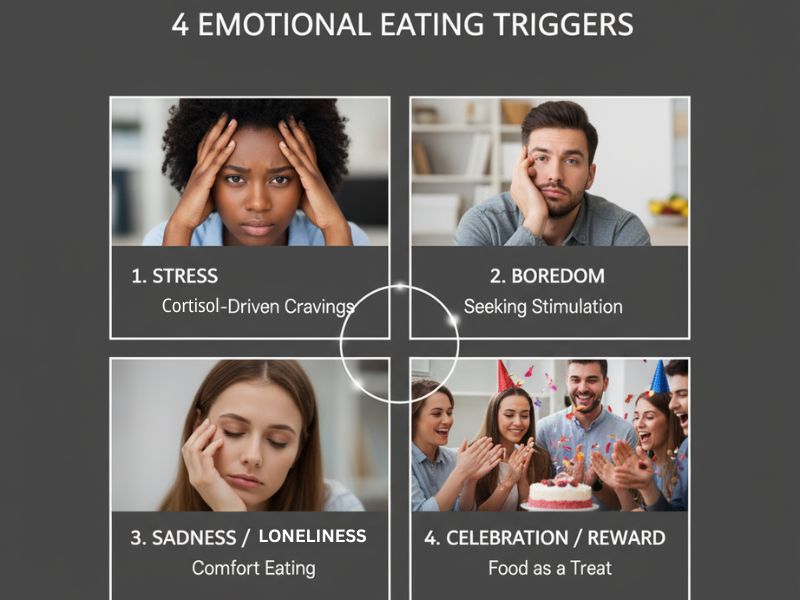
Moral Judgment Shame: “I’m So Bad With Food”
This is the most common shame signature, and it creates the strongest immediate cortisol response.
Why it’s particularly damaging: Binary language (“bad” vs “good”) triggers all-or-nothing physiology. Your body doesn’t do moderation when it detects a moral threat – it goes into full emergency mode.
Typical effects:
- Strongest initial cortisol spike
- Most likely to trigger binge-eating behaviors
- Disrupts blood sugar control for 3-6 hours after the thought
- Creates the classic “I’ve already ruined it, might as well keep eating” pattern
Why you sabotage your diet with this pattern: The moral judgment creates such intense shame that eating MORE actually becomes a way to numb the shame temporarily. It’s a vicious cycle – shame drives eating, eating creates more shame, more shame drives more eating.
Identity Attack Shame: “I’m Pathetic/Disgusting”
This shame signature goes even deeper than moral judgment. It attacks your fundamental worth as a person.
Why it’s particularly damaging: Identity-level threats activate the most primitive survival responses. Your brain perceives this as existential danger.
Typical effects:
- Activates the deepest survival mechanisms
- Triggers inflammatory markers (cytokines) in addition to cortisol
- Creates the longest-lasting metabolic disruption – up to 12 hours
- Often leads to complete eating pattern collapse for the day
Why this drives self sabotage with food: When your brain believes your core identity is threatened, it prioritizes immediate survival (eating for energy) over long-term health goals. Your goals become irrelevant when survival mode is activated.
Comparison Shame: “Everyone Else Can Do This, Why Can’t I?”
This shame signature combines threat detection with social rejection processing – a particularly toxic combination.
Why it’s particularly damaging: You’re simultaneously activating the “I’m inadequate” response AND the “I’m socially rejected” response. Both are powerful survival threats.
Typical effects:
- Elevates both cortisol and inflammatory cytokines
- Creates anxiety in addition to metabolic disruption
- Most likely to disrupt sleep patterns (shame + social anxiety keep you awake)
- Next-day glucose control suffers significantly
Why this pattern creates food self sabotage: The social comparison component creates additional stress beyond personal shame. Moreover, disrupted sleep from nighttime anxiety then sets up poor food choices and worse blood sugar control the following day.
Future-Focused Shame: “I’ll Never Get Healthy”
This shame signature is insidious because it feels like realistic assessment rather than harsh judgment.
Why it’s particularly damaging: Hopelessness creates a state called “learned helplessness” – and that state has specific physiological signatures, including chronic cortisol elevation.
Typical effects:
- Creates chronic low-level stress activation (not spikes, but sustained elevation)
- Leads to sustained insulin resistance patterns
- Most damaging to long-term metabolic health
- Gradually worsens glucose control over weeks and months
Why this drives diet sabotage: If your brain believes effort is futile, it stops prioritizing long-term goals. Why resist food cravings if you’re “never going to get healthy anyway”? The hopelessness becomes a self-fulfilling prophecy through its metabolic effects.
Why You Can’t “Willpower” Your Way Out of Self Sabotage With Food
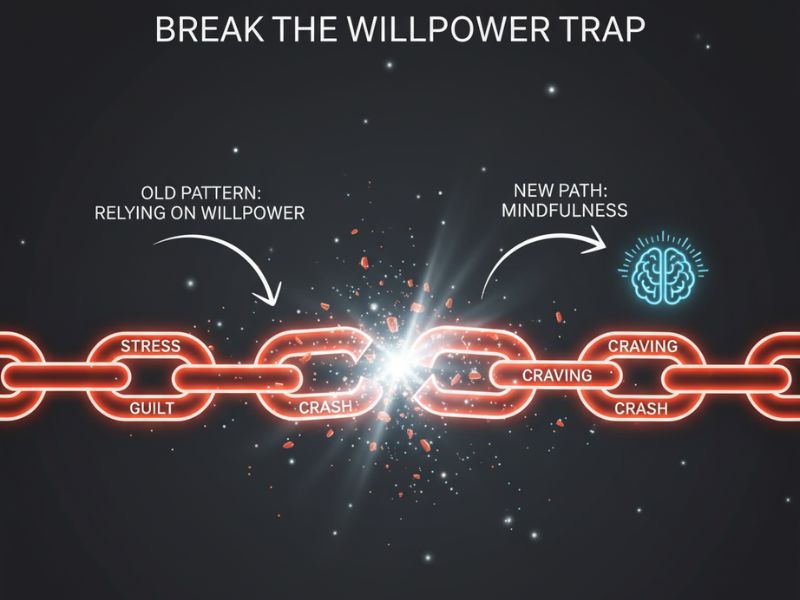
Here’s the truth that most diet advice completely misses: you cannot willpower your way out of a stress response.
In fact, trying to use willpower against shame-based food urgency is like trying to hold your breath indefinitely. Your survival system will override your conscious intentions every single time.
I learned this the hard way, both personally and professionally. As a pharmacist dispensing diabetes medications and weight management drugs, I started noticing a pattern: the patients who struggled most with blood sugar control weren’t necessarily the ones with the worst diets.
They were the ones with the harshest internal dialogue.
The ones who said things like “I’m disgusting,” “I have no self-control,” “I’m pathetic” – these patients consistently showed higher A1C levels, more variable glucose readings, and greater insulin resistance than patients who ate similarly but spoke to themselves with more compassion.
This observation led me to dive into the research, and what I found was remarkable.
The Research That Changes Everything
Research on shame and metabolic health reveals important connections. Studies show that shame-based self-talk is associated with:
- Elevated cortisol levels and inflammatory markers
- Disrupted blood sugar patterns
- Greater difficulty maintaining behavioral changes
- Increased stress-related eating behaviors
In my years as a pharmacist in Cape Town, I’ve observed a pattern: patients who speak harshly to themselves about food often struggle more with blood sugar control than their diets alone would predict.
Many don’t realize they’re dealing with insulin resistance until these stress patterns become severe—learn how to recognize insulin resistance signs at home before chronic shame compounds the problem.
While we need more research to fully understand this relationship, the connection between shame, stress, and metabolism is clear enough to take seriously.
This explains why traditional “just eat better” advice fails so spectacularly. You’re trying to change behavior while ignoring the stress response that’s driving that behavior.
It’s like trying to bail water out of a boat while ignoring the hole in the hull. You can work harder and harder, but you’re not addressing the actual problem.
Every time you think “Why do I self sabotage with food?” the real answer is: because you’re adding stress to an already stressed system. The shame itself is creating the metabolic chaos that drives the eating.
Self-Compassion: The Antidote to Food Self Sabotage
Now for the beautiful flip side: just as shame creates measurable metabolic damage, self-compassion creates measurable metabolic healing.
This isn’t just “being nice to yourself.” This is medicine for your metabolism.
Research on self-compassion and health markers shows that people who practice compassionate self-talk have:
- More stable blood sugar patterns throughout the day
- Lower inflammatory markers (including those cytokines that shame triggers)
- More predictable insulin responses
- Significantly fewer food cravings and urgency
- Better sleep quality and hormone balance
- Lower cortisol levels overall
Self-compassion literally calms your nervous system. When your brain doesn’t perceive identity threats, it doesn’t activate survival responses. Without the survival response, you don’t get the cortisol spike, the glucose flood, the insulin chaos, or the urgent food cravings.
It’s not that self-compassionate people have better willpower. They have calmer nervous systems. And calm nervous systems don’t drive compulsive eating.
Recognizing Your Self Sabotage Patterns: The Shame Signature Tracker
Most people don’t even realize how often they engage in metabolically damaging self-talk. The thoughts are so automatic, so normalized, that they become invisible.
Here’s how to start seeing your patterns. For the next three days, simply notice when you use these phrases. Don’t try to change them yet – just notice.

High-Alert Shame Triggers
These phrases create immediate, intense stress responses:
- “I’m so bad with food”
- “I’m disgusting/pathetic”
- “I have no willpower/self-control”
- “I’m a failure at this”
- “I’m never going to succeed”
If you catch yourself using these, you’re likely experiencing strong cortisol spikes and blood sugar instability within minutes.
Medium-Alert Shame Triggers
These create moderate stress responses that accumulate over time:
- “I should know better”
- “This is embarrassing”
- “I can’t believe I did that again”
- “Other people don’t struggle like this”
- “What’s wrong with me?”
These may not create immediate food urgency, but they contribute to chronic stress elevation that makes you more vulnerable to self sabotage with food later.
Low-Level Chronic Shame
These phrases fly under the radar but create sustained metabolic stress:
- “I’m not the type of person who…”
- “I’m just not good at healthy eating”
- “I don’t have what it takes”
- “This is just how I am”
- “I always do this”
Low-level chronic shame is particularly insidious because it doesn’t feel dramatic. However, sustained activation of your stress system – even at low levels – creates insulin resistance patterns over time.
Your tracking exercise:
For three days, simply make a tally mark each time you notice yourself using one of these phrases. Don’t judge yourself for having the thoughts (that’s just more shame!). Just observe.
At the end of three days, you’ll likely be shocked by:
- How frequent these thoughts are
- Which shame signature you use most
- What situations trigger your specific pattern
This awareness alone begins to interrupt the automatic cascade.
Breaking the Self Sabotage Cycle: The R.E.A.L. Method
Once you’ve identified your shame signatures, you need a practical way to interrupt the pattern in real-time. That’s where the R.E.A.L. method comes in.
This isn’t about positive thinking or affirmations. This is about giving your brain accurate information so it can turn off the threat response.
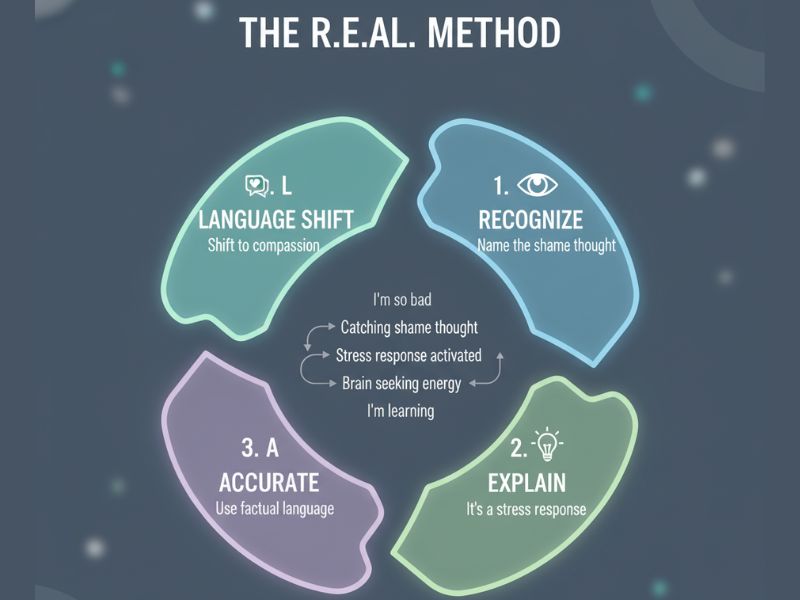
R – Recognize the Shame Phrase
The moment you notice shame-based self-talk, simply name it: “I’m catching myself saying ‘I’m so bad.'”
This recognition creates a crucial pause. Instead of the thought leading directly to the stress cascade, you’ve inserted awareness. That awareness interrupts the automatic response.
E – Explain What’s Actually Happening
Remind yourself of the mechanism: “My body is responding to what it thinks is a threat to my identity.”
This shifts you from emotional reaction to scientific observation. Your brain literally processes information differently when you’re in “observer mode” versus “threat mode.”
A – Accurate Language
Replace the shame phrase with physiologically accurate language: “My brain is seeking energy because it detected blood sugar instability from the stress response.”
This isn’t denial or sugarcoating. It’s accurate. Your cravings ARE driven by blood sugar chaos, which IS triggered by the stress response, which IS activated by shame-based thinking.
Accurate language deactivates the threat response because your brain recognizes: “Oh, there’s no actual danger here. This is just a thought pattern.”
L – Language Shift
Use a compassionate reframe that acknowledges your humanity: “I’m learning how my physiology works, and that’s valuable.”
This final step redirects your focus from judgment to curiosity, from shame to understanding. Therefore, you’re working WITH your nervous system instead of against it.
R.E.A.L. Method Examples
Situation: You just ate lunch and think “I’m so bad with food”
R – Recognize: “I’m catching that ‘I’m so bad’ thought”
E – Explain: “This thought is triggering my stress response”
A – Accurate: “My body is having a normal response to perceived threat”
L – Language Shift: “I’m learning to recognize these patterns, which is progress”
Situation: You want a snack and think “I have no self-control”
R – Recognize: “There’s that ‘no self-control’ thought”
E – Explain: “This shame thought is actually creating food urgency”
A – Accurate: “My brain is doing what it evolved to do – seek energy when it detects stress”
L – Language Shift: “I can work with my biology instead of fighting it”
Situation: You compare yourself and think “Everyone else can do this, why can’t I?”
R – Recognize: “I’m in comparison shame right now”
E – Explain: “This is combining identity threat with social rejection – a double stress hit”
A – Accurate: “My stress response is elevated because of the thought pattern, not because I’m actually inadequate”
L – Language Shift: “Everyone’s physiology is different, and I’m figuring out mine”
The R.E.A.L. method takes practice. At first, it might feel awkward or forced. That’s normal. In fact, you’re building new neural pathways, and that takes repetition.
But here’s what changes immediately: even imperfect use of this method interrupts the automatic shame cascade. That interruption alone reduces the cortisol spike, which reduces the blood sugar chaos, which reduces the food urgency.
You don’t have to be perfect at it. You just have to pause long enough to give your brain different information.
Ready to break the shame-stress-eating cycle for good?
Your Body Is Talking: A Pharmacist’s Guide to Stopping Prediabetes is a free guide that explains exactly what’s happening — and what to do about it. No meal plans. No shame. Just clarity.
What Changes When You Stop Self Sabotage With Food
When you begin working with your shame physiology instead of against it, several things shift – some immediately, some over time.
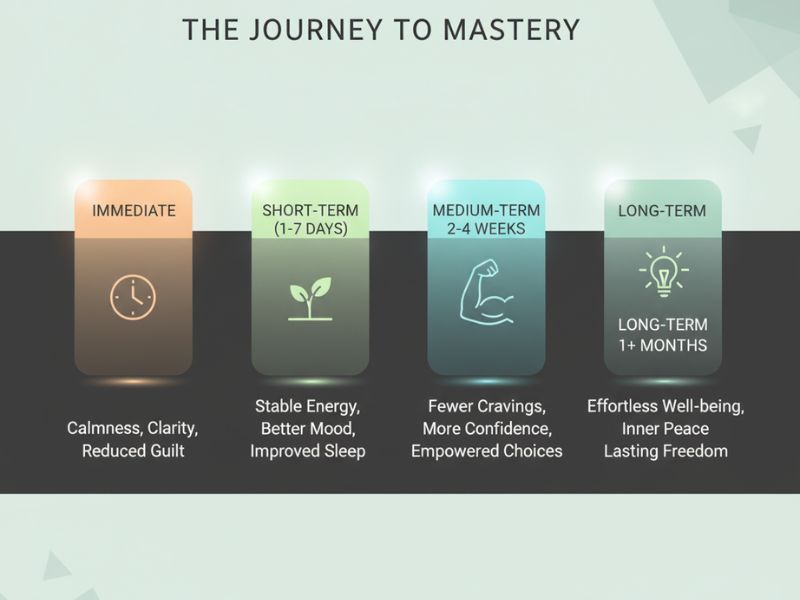
Immediate Changes (Within Days)
- Awareness itself interrupts automatic patterns. Just noticing “I’m having a shame thought” creates a gap between thought and action.
- Reduced intensity of food urgency. The compulsive quality of cravings decreases when you’re not adding shame-based stress.
- Better recognition of actual hunger vs. stress-driven eating. Without constant cortisol interference, your natural hunger signals become clearer.
Short-Term Changes (Within Weeks)
- More stable energy throughout the day. Less shame means less cortisol chaos, which means more stable blood sugar.
- Fewer binge episodes. The all-or-nothing eating patterns start to fade as shame-based thinking decreases.
- Better sleep quality. Without shame disrupting your evening cortisol patterns (as we discussed in the nighttime cravings post), sleep improves.
Medium-Term Changes (Within Months)
- Improved glucose control. If you’re tracking blood sugar, you’ll see more stability and better numbers.
- Weight stabilization. Not necessarily dramatic weight loss, but an end to the chaotic up-and-down patterns.
- Different relationship with food. Food stops feeling like the enemy or your greatest weakness. It becomes neutral again.
Long-Term Changes (Within a Year)
- New neural pathways. Self-compassion becomes more automatic; shame-based thinking becomes the exception rather than the rule.
- Metabolic healing. Insulin sensitivity improves, inflammatory markers decrease, hormone balance restores.
- Freedom from the sabotage cycle. You stop asking “why do I sabotage my diet?” because you’re no longer doing it.
Understanding this cascade doesn’t erase years of established patterns overnight, but it does give you a place to start interrupting them. The timeline varies for everyone. Some people notice changes within days; others take months. What matters is understanding that these changes are possible – and they come from addressing the stress response, not from having better willpower.

Your Body Has Been Trying to Protect You
Here’s what I want you to understand: self sabotage with food isn’t evidence that you’re broken or weak or lacking discipline.
It’s evidence that your body has been trying desperately to protect you from threats that exist only in your thoughts.
Every time you’ve eaten after saying “I’m so bad,” your body was doing exactly what it evolved to do – seeking quick energy in response to what it perceived as danger.
The problem wasn’t your body. The problem was the false alarm.
Now you know how to turn off that alarm. You know that “I’m so bad” triggers the same neural pathways as physical pain. Different shame signatures create different metabolic chaos. Here’s what matters most: self-compassion isn’t weakness – it’s medicine.
Most importantly, you know that you can learn to work WITH your physiology instead of constantly fighting against it.
In my next post, we’ll explore another powerful shame trigger: body image self-talk and its direct impact on glucose control. You’ll discover why that critical voice in the mirror is literally affecting your metabolic health.
For now, start tracking your shame signatures. Notice which phrases show up most often. Practice the R.E.A.L. method when you catch yourself in shame-based thinking.
Your awareness alone begins the healing process.
Important Note
While self-criticism and shame affect metabolism, persistent blood sugar issues, difficulty maintaining healthy eating patterns, or concerns about your metabolic health require professional medical evaluation. If you experience symptoms of diabetes, insulin resistance, or metabolic dysfunction, consult a healthcare provider. This content is educational, not medical advice.
Medical Disclaimer
This blog post is for educational and informational purposes only and is not intended as medical advice. I am a licensed pharmacist sharing evidence-based health information, but I am not your healthcare provider.
If you have been diagnosed with insulin resistance, prediabetes, diabetes, or any other medical condition, consult with your doctor or qualified healthcare professional before making changes to your diet, exercise routine, or medication regimen. Individual health circumstances vary, and what works for one person may not be appropriate for another.
The information provided here is based on current scientific understanding and clinical evidence, but it does not replace personalized medical guidance from a healthcare provider who knows your complete medical history.
If you experience any concerning symptoms or have questions about your specific health situation, please seek professional medical advice.
References
- Dickerson, S. S., Kemeny, M. E., Aziz, N., Kim, K. H., & Fahey, J. L. (2004). “Immunological effects of induced shame and guilt.” *Psychosomatic Medicine*, 66(1), 124-131. https://pubmed.ncbi.nlm.nih.gov/14747646/
- Breines, J. G., Thoma, M. V., Gianferante, D., Hanlin, L., Chen, X., & Rohleder, N. (2014). “Self-compassion as a predictor of interleukin-6 response to acute psychosocial stress.” *Brain, Behavior, and Immunity*, 37, 109-114. https://pubmed.ncbi.nlm.nih.gov/24239953/