

Omega-3 and blood sugar. Does it help?
Walk into any pharmacy and you will find omega-3 supplements taking up an entire shelf. It is one of the most purchased supplements in the world. But most people buying it have no idea what it actually does — or whether it has anything to do with their blood sugar.
As a pharmacist, I get asked about omega-3 regularly. And the honest answer is this: omega-3 is not a blood sugar drug. It does not work like metformin. It does not directly lower your glucose reading the morning after you take it.
What it does is something more important — and more lasting.
This blog explains the real connection between omega-3 and blood sugar, why most people are deficient, and what to look for if you decide to supplement. If you are new to the supplementation conversation, start with Vitamins for Insulin Resistance: What Actually Works — it covers the broader landscape before we go deep on omega-3 here.
Disclaimer: This article is for educational purposes only and does not constitute medical advice. Consult your healthcare provider or pharmacist before starting any new supplement, especially if you are taking chronic medication or have a diagnosed condition. The information here is general — it is not a substitute for an individual consultation.
Omega-3 and Blood Sugar: What Is the Real Connection?
Omega-3 is a type of polyunsaturated fatty acid. There are three main forms you need to know about.
ALA (alpha-linolenic acid) is found in plant sources like flaxseed and walnuts. Your body can convert ALA into the active forms — but the conversion rate is poor. Less than 10% makes it through.
EPA (eicosapentaenoic acid) and DHA (docosahexaenoic acid) are the forms your body actually uses. These come primarily from fatty fish — salmon, sardines, mackerel, anchovies — and from algae, which is where the fish get it in the first place.
When people talk about the health benefits of omega-3, they are talking about EPA and DHA. Not ALA. This distinction matters when you are standing in the supplement aisle deciding what to buy.
Whole food sources of EPA and DHA — fatty fish and algae — also deliver protein and important micronutrients alongside the omega-3. If you are eating two to three servings of oily fish per week, you may not need a supplement at all. For most people, that level of intake is not happening — which is where supplementation becomes relevant.
The Omega-6 to Omega-3 Ratio — The Problem Nobody Talks About

Your body needs both omega-6 and omega-3 fatty acids. The ratio between them is what determines whether your inflammatory response stays balanced — or runs out of control.
The ideal ratio is approximately 4:1. Omega-6 to omega-3.
The modern diet delivers something closer to 20:1. In some populations, it is as high as 40:1.
This has happened because of one shift in the food supply: the rise of vegetable oils. Sunflower oil, canola oil, corn oil, soybean oil — these are all extremely high in omega-6. They are in almost every processed food, fast food item, and restaurant meal you encounter. Meanwhile, the fatty fish and grass-fed animal products that supplied omega-3 to previous generations have been largely replaced by grain-fed alternatives with a very different fatty acid profile.
The result is a population that is chronically deficient in omega-3 — not because they are eating badly by their own standards, but because the food environment has shifted underneath them without announcement.
This ratio matters for one specific reason: omega-6 and omega-3 compete for the same enzymes. When omega-6 dominates, it drives the production of pro-inflammatory compounds. When omega-3 is present in adequate amounts, it produces anti-inflammatory compounds instead.
Chronic inflammation is not an abstract concept. It has a direct metabolic consequence.
How Inflammation Connects to Blood Sugar
Inflammation and insulin resistance are not separate problems. They are the same problem expressing in different ways.
Here is the mechanism. Chronic low-grade inflammation — the kind that runs silently in the background without obvious symptoms — interferes with insulin signaling at the cellular level. When inflammatory cytokines are elevated, the insulin receptor on the cell surface becomes less responsive. The cell starts ignoring insulin’s signal. Glucose stays in the bloodstream instead of entering the cell. Blood sugar rises.
This is insulin resistance. And inflammation is one of its primary drivers. To understand exactly how insulin signalling works inside the body, read: What Does Insulin Do to Your Body — it explains the mechanism clearly before we look at what disrupts it.
There is a further layer. A diet dominated by ultra-processed, high-heat vegetable oils — combined with other processed food components — damages the gut lining over time. A damaged gut lining allows bacterial fragments called lipopolysaccharides — LPS — to leak into the bloodstream. LPS triggers a powerful inflammatory response. That response worsens insulin resistance further. One of the most under appreciated drivers of this inflammatory load is sugar itself. Does Sugar Cause Inflammation explains exactly how excess sugar feeds the inflammatory cycle that makes insulin resistance worse.
The full cycle looks like this: poor diet → gut damage → LPS leakage → systemic inflammation → worsening insulin resistance → higher blood sugar → more metabolic stress → more inflammation.
Omega-3 interrupts this cycle. Not by lowering blood sugar directly — but by reducing the inflammatory burden the body is carrying. When inflammation drops, insulin sensitivity improves. When insulin sensitivity improves, blood sugar regulation improves with it.
What the Research Says About Omega-3 and Blood Sugar
The evidence on omega-3 and metabolic health is substantial — but it is important to understand what the research actually shows rather than what supplement marketing claims.
Triglycerides: This is where the evidence is strongest. Omega-3 supplementation consistently reduces triglyceride levels, often significantly. High triglycerides are closely linked to insulin resistance and metabolic syndrome. Bringing them down is a meaningful metabolic improvement.
Insulin sensitivity: Multiple studies show that omega-3 supplementation improves insulin sensitivity, particularly in people with elevated inflammation markers. The effect is more pronounced in people who are more insulin resistant to begin with.
Fasting glucose: The effect on fasting blood glucose is more modest. Some studies show improvement, others show neutral results. The honest answer is that omega-3 is not a reliable glucose-lowering agent on its own.
The bottom line: Omega-3 works upstream. It reduces inflammation, improves the environment in which insulin operates, and supports the conditions under which blood sugar regulation can improve. Not a replacement for dietary change, exercise, or sleep. It is a tool that removes an obstacle — chronic inflammation — that is working against every other effort you are making.
What Type of Omega-3 Works for Blood Sugar?
Not all omega-3 supplements are equal. This is one area where quality matters more than most people realise.
EPA vs DHA
Both matter for metabolic health. EPA appears to have a stronger effect on inflammation and insulin sensitivity specifically — look for a supplement that provides a meaningful dose of EPA rather than one where DHA dominates.
Quality certification
Fish oil oxidises. Rancid fish oil does not just smell bad — it delivers oxidized lipids that can increase inflammation rather than reduce it. Look for supplements certified by IFOS (International Fish Oil Standards) or produced to GOED standards. These certifications confirm purity, potency, and absence of heavy metals.
Dosage
A maintenance dose is typically 1,000mg of combined EPA and DHA per day. A therapeutic dose — the kind used in research showing meaningful metabolic effects — is closer to 2,000–4,000mg of combined EPA and DHA per day. The total milligrams on the front of the bottle refers to fish oil, not EPA and DHA. Always check the nutritional information panel for the actual EPA and DHA content.
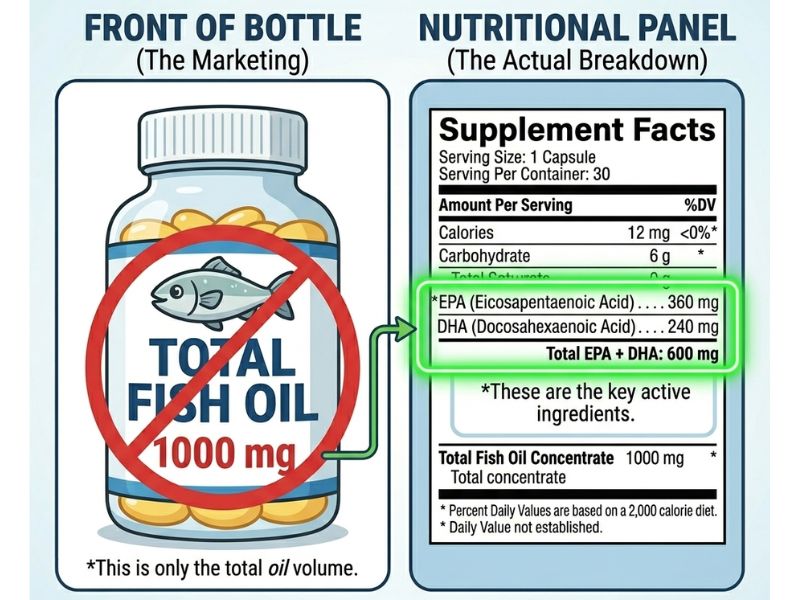
In South Africa
Look for products that display their EPA and DHA content clearly on the label. Brands available at Dis-Chem and Clicks vary significantly in quality. When in doubt, ask your pharmacist to help you read the label.
Pete’s Take on Omega-3 and Blood Sugar

Pete the pancreas has been working overtime. Every time inflammation flares, the insulin he produces gets ignored — like sending a message that never gets delivered. Cells become less responsive. Pete has to produce more and more insulin just to get the same result.
Omega-3 does not fix Pete directly. What it does is quiet the inflammatory noise that is drowning out his signal. When the noise drops, the message gets through. Pete can work at normal capacity again instead of pushing against resistance all day.
That is not a cure. But it is a meaningful improvement in the environment Pete has to work in every day.
Omega-3 and Blood Sugar: The Bottom Line
Omega-3 is not a blood sugar medication. Do not expect it to replace dietary change, movement, or sleep. Those remain the foundation. If you want to know which foods actively support this process from the ground up, Foods to Reverse Prediabetes: A Pharmacist’s Guide is the natural companion read.
If you are eating two to three servings of oily fish per week, you may already be getting what you need from food alone. For most people managing prediabetes, that level of intake is not happening — and a quality supplement becomes worth considering.
What omega-3 does is address one of the most common and under appreciated drivers of insulin resistance — chronic inflammation. By restoring a healthier omega-6 to omega-3 ratio, supporting gut integrity, and reducing systemic inflammatory load, it improves the conditions under which your body manages blood sugar.
For someone managing prediabetes, that is worth taking seriously.
[Download your FREE ebook — Your Body Is Talking: A Pharmacist’s Guide to Stopping Prediabetes]
Disclaimer: This article is for educational purposes only and does not constitute medical advice. Consult your healthcare provider or pharmacist before starting any new supplement, especially if you are taking chronic medication or have a diagnosed condition. The information here is general — it is not a substitute for an individual consultation.
References
- Simopoulos AP. The importance of the omega-6/omega-3 fatty acid ratio in cardiovascular disease and other chronic diseases. Experimental Biology and Medicine. 2008;233(6):674-688. Available at: https://journals.sagepub.com/doi/10.3181/0711-MR-311
- Kalupahana NS, Claycombe KJ, Moustaid-Moussa N. (n-3) Fatty acids alleviate adipose tissue inflammation and insulin resistance: mechanistic insights. Advances in Nutrition. 2011;2(4):304-316. Available at: https://pubmed.ncbi.nlm.nih.gov/22332072/
- Cani PD, et al. Metabolic endotoxemia initiates obesity and insulin resistance. Diabetes. 2007;56(7):1761-1772. Available at: https://diabetesjournals.org/diabetes/article/56/7/1761/12590
- Jackowski SA, et al. Oxidation levels of North American over-the-counter n-3 supplements and the influence of supplement formulation and delivery form on evaluating oxidative safety. Journal of Nutritional Science. 2015;4:e30. Available at: https://www.cambridge.org/core/journals/journal-of-nutritional-science/article/oxidation-levels-of-north-american-overthecounter-n3-omega3-supplements/3678444D6D1E7A80E8D7BB1345D51B73