

Does exercise raise blood sugar? If you’ve ever finished a workout and seen a higher number on your glucose monitor, you already know the answer can be yes — and you deserve to know why.
Tom was doing everything right.
High-intensity cardio five times a week. Weight training three times a week. Ten thousand steps every single day. He was exhausted, but he was following the plan. He had prediabetes and he was going to fix it.
His blood sugar was becoming more variable, not more stable.
“Exercise is supposed to help diabetes,” he told me, feeling frustrated. “Why am I working this hard and seeing inconsistent results?”
Nobody had told Tom the part that changes everything: pushing beyond what your body can currently recover from doesn’t always lower blood sugar. It can trigger a stress response. And stress responses raise it.

Yes, Exercise Can Raise Blood Sugar — Here’s Why That’s Not the Whole Story
If you’ve checked your glucose after a hard workout and seen a number higher than before you started, you’re not imagining it. You’re not broken. And you’re not alone.
Does exercise raise blood sugar? Sometimes, yes. But that answer without context is the reason so many people with prediabetes end up confused, discouraged, and ready to quit something that could genuinely help them.
The full answer is this: exercise raises blood sugar in certain conditions. And once you understand those conditions, you can work with your body instead of triggering it.
The Cortisol Connection — How Exercise Can Spike Blood Sugar
Your body has a stress response system that evolved long before gym memberships existed. When it perceives significant physical stress — the kind that comes from pushing hard, going long, and not recovering enough — it releases stress hormones, including adrenaline and cortisol.
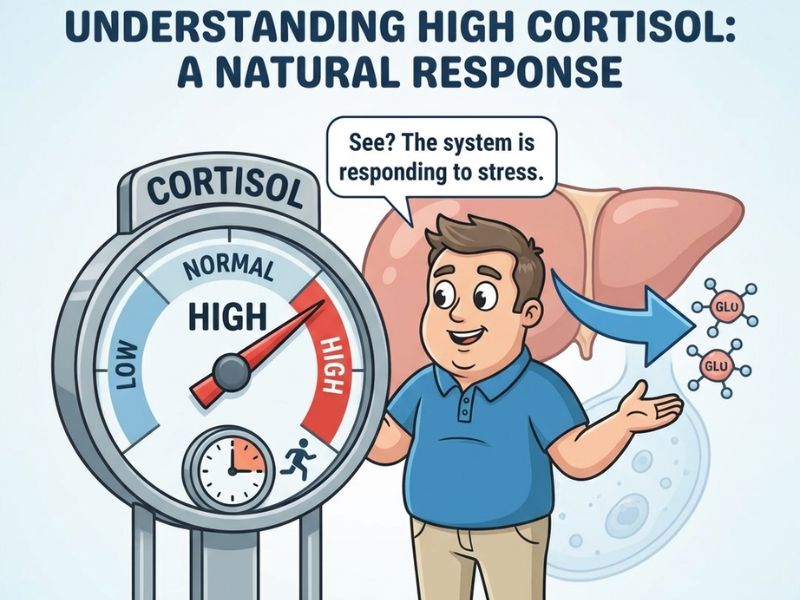
Adrenaline acts fast. It signals your liver to release glucose for immediate energy. Cortisol follows, sustaining that release over time. Together, they raise your blood sugar.
This isn’t a malfunction. It’s your body preparing you to manage a threat. The problem is that your body cannot tell the difference between the stress of a difficult workout and the stress of an actual emergency. It responds to the signal, not the source.
So you finish a hard session, feel like you’ve done something good, check your glucose — and the number is higher than when you started.
Tom’s body wasn’t failing him. It was doing exactly what a stressed body does.
The Problem Isn’t Exercise. It’s Why Your Blood Sugar Keeps Rising.
Here’s the part that often goes unexplained.
A body with prediabetes is already carrying a metabolic stress load. Insulin isn’t working as efficiently as it should. The system is already managing more than it would like to. Adding high-intensity exercise on top of that is like giving more urgent assignments to a team that’s already overwhelmed.
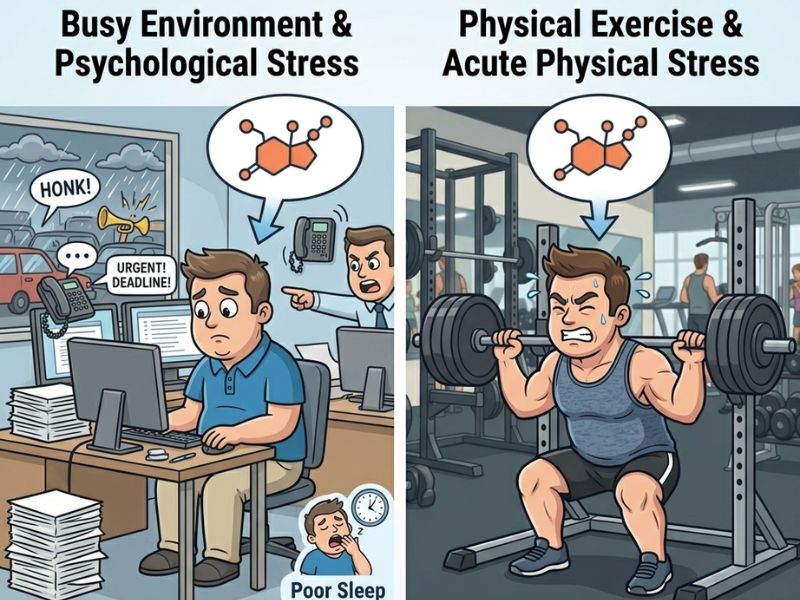
Your body cannot tell the difference between gym stress and life stress. Both arrive as the same chemical signal. And when that signal is already present before you start your workout, the threshold for triggering a cortisol response is lower than you’d expect.
This doesn’t happen to everyone. Individual variation is real — some people with prediabetes handle high-intensity exercise well, particularly as their metabolic health improves.
But it happens enough to be worth knowing: if your blood sugar is unpredictable on workout days, how hard you’re training and how well you’re recovering between sessions are likely the cause.
If you want to understand how that stress signal affects your blood sugar beyond the gym, does stress affect blood sugar covers the full picture.
What Tom Did Differently — The Four Movement Types That Work With Your Body
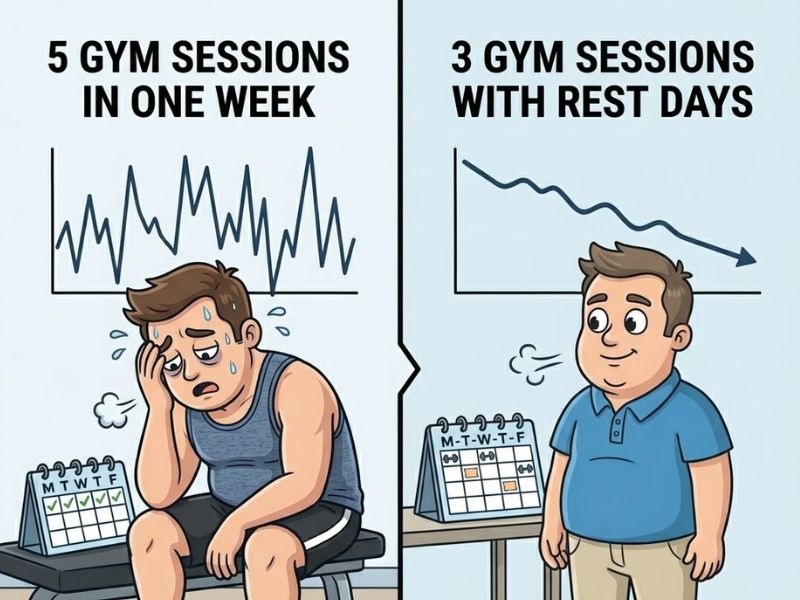
Tom made one change. He cut his gym sessions from five days a week to three and added proper rest days. His body finally had space to recover.
When he stopped fighting his body’s signals and started working with them, his A1C decreased almost a full point in six weeks.
That kind of result sounds remarkable until you understand what was actually happening. Tom wasn’t adding something new. He was removing the thing that was actively blocking everything his body was already trying to do.
When the stress signal stopped arriving five days a week, insulin sensitivity had room to recover, sleep improved, inflammatory load decreased, and glucose regulation stabilized — all at once. It is very easy to do once you understand what is happening.
He didn’t move less. He moved smarter.
I’ve been exercising longer than I’ve been a pharmacist. I started going to the gym as a scrawny kid with my cousins who played rugby. The gym owner trained alongside us and taught us correct technique from the beginning — something I’m deeply grateful for, because the gym is not a beginner-friendly environment. Nobody tells you what not to do.
One of the most important lessons I learned early stays with me today: rest is as much a part of training as the gym session itself. It’s also the lesson most people with prediabetes have never been given about exercise. They’ve been told to do more. Nobody told them that doing less, done consistently, often produces better results — especially for blood sugar.
Here are four types of movement that tend to support blood sugar rather than spike it:
Type 1 — Gentle Daily Movement

Walking after meals, light stretching, playing with your kids or your dog, basic household tasks. Your muscles use glucose for fuel without triggering significant stress responses. This is the lowest-risk, highest-consistency option available to you — and it works.
Type 2 — Enjoyable Regular Movement
Dancing, hiking, swimming, gardening, recreational sports you genuinely look forward to. There’s a physiological reason enjoyment matters here — when you enjoy what you’re doing, your body operates in a more balanced state. The physical activity is similar, but your glucose regulation system works with you rather than against you.
Type 3 — Natural Daily Movement
Taking the stairs, parking a little further away, walking meetings, household projects. Your body evolved to move throughout the day — not to sit for eight hours and then exercise intensely for one. Natural movement keeps glucose processing steadier across the whole day.
Type 4 — Stress-Relief Movement
Easy yoga, leisurely walks, gentle stretching, mobility work. This type directly counters the stress hormones that affect blood sugar. You’re moving your body from heightened alert toward a calmer state — and your glucose follows.

If you want the full picture on structured exercise that supports insulin sensitivity, exercise for insulin resistance covers it in detail.
How to Know If This Is Happening to You
Not every exercise routine needs to change. The question is whether yours is working with your body or against it right now.
Understanding whether exercise raises your blood sugar comes down to observing your own pattern.
One important note before the self-assessment: if you’re taking any medication for blood sugar, blood pressure, or heart health, speak to your pharmacist or doctor before making significant changes to your exercise routine. Exercise interacts with several common medications in ways that are worth discussing with someone who knows your full picture.
Signs Your Movement Is Supporting Your Blood Sugar
You feel energized after your session, not depleted. Your readings are becoming more consistent, including on workout days. You look forward to moving — it doesn’t feel like punishment. You sleep better on days you’ve moved.
Signs Your Intensity May Be Working Against You
You feel exhausted for hours or days after a session. Your blood sugar is more unpredictable on workout days specifically. You dread your exercise time more often than not. You need extended recovery before you feel normal again.
If you’re seeing the second list more than the first, try this: cut your workout intensity or duration by half for one week and observe what happens to your readings. The experiment takes seven days. The information it gives you is worth far more than the workouts you scaled back.
The Bottom Line: Does Exercise Raise Blood Sugar for You?
Exercise is one of the most powerful tools available for prediabetes. That hasn’t changed. The question was never whether to move — it was always which signal your body needs right now.
Tom didn’t stop exercising. He stopped overwhelming a body that was already stretched. He gave it movement it could use, recovery it could build on, and space to show him what it was capable of.
Does exercise raise blood sugar? Sometimes. Under specific conditions, with specific intensity, without enough recovery, in a body that’s already managing more than it can handle — yes.
But the same body, given the right kind of movement, done consistently, with enough recovery to let the benefits land?
That body changes.
And one more thing — because this matters as much as anything else in this blog.
Falling off is part of the journey. Nobody maintains a perfect movement routine indefinitely. Life happens, priorities shift, and sometimes you end up at the very bottom of your own list. That’s okay. What matters is that you start again. Start small. Be consistent. And when you have that momentum back and fall off again — because you will — that’s not failure. That’s the journey. It is not about perfection. It is about keeping on keeping on.
Ready to Find What Works for Your Body?

If this is making sense and you want support putting it into practice, the free ebook — Your Body Is Talking: A Pharmacist’s Guide to Stopping Prediabetes — walks you through the full picture. Chapter 6 goes deeper into the movement system that works with your body’s signals, not against them.
Download it free at helpingprediabetics.com.
References:
- American Diabetes Association. Why Does Exercise Sometimes Raise Blood Sugar? Diabetes.org. 2024. https://www.diabetes.org/healthy-living/fitness/why-does-exercise-sometimes-raise-blood-sugar
- Strickland JC, et al. Aerobic Exercise Training Modalities and Prediabetes Risk Reduction. PubMed. 2016. https://pubmed.ncbi.nlm.nih.gov/27776003/
- Church TS, et al. Effects of Aerobic and Resistance Training on Hemoglobin A1c Levels in Patients With Type 2 Diabetes. PMC. 2010. https://pmc.ncbi.nlm.nih.gov/articles/PMC3174102/