
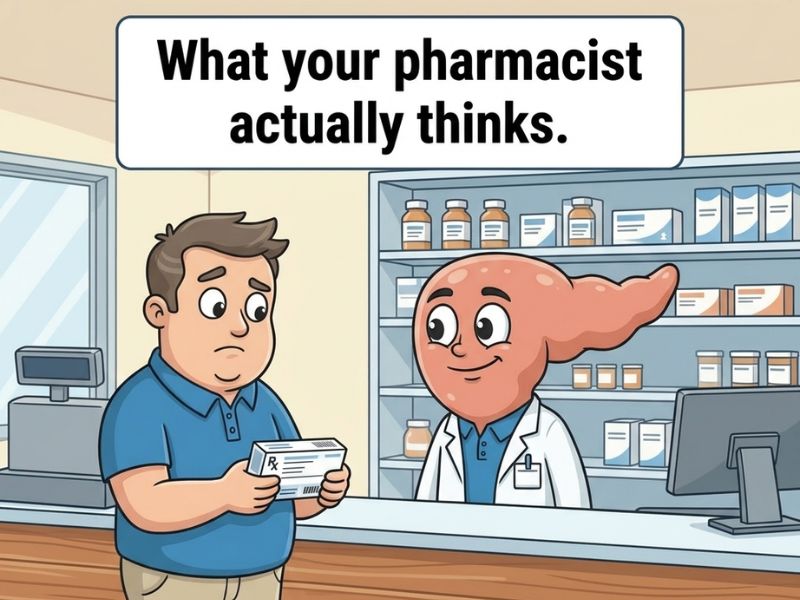
Are you thinking of using Ozempic for your prediabetes diagnosis?
Your result came back higher than normal. Not diabetic — but not where it should be. The doctor said the word “prediabetes,” handed you some information, and told you to come back in three months.
On the drive home, you picked up your phone. And somewhere in those search results, Ozempic for prediabetes appeared.
Of course it did. Ozempic is everywhere right now — in the news, on social media, in conversations at the office. People are losing weight on it. People are talking about their blood sugar coming down. If you have a prediabetes result sitting in your hand, it makes complete sense that your brain went there.
So let’s talk about it honestly. I’m a pharmacist with 18 years of experience. I’ve dispensed Ozempic multiple times. I’ve answered questions about Ozempic for prediabetes at the dispensary counter more times than I can count. Here is what I actually think.
What Is Ozempic and How Does It Work?
Ozempic is the brand name for a medication called semaglutide. It belongs to a class of drugs known as GLP-1 receptor agonists — which means it mimics a hormone your gut naturally releases after you eat.
That hormone, GLP-1, does several things at once. It signals your pancreas to release insulin in response to rising blood sugar. Your liver gets signaled to slow down its glucose output. It slows the rate at which food leaves your stomach, so you feel fuller for longer and your blood sugar doesn’t spike as sharply after meals. And it acts on the appetite centres in the brain, quietly turning down the volume on hunger.
The result is better blood sugar control, less appetite, and — in most people — meaningful weight loss. It is injected once a week using a pre-filled pen.
Ozempic was originally approved for type 2 diabetes. The weight loss was a side effect that showed up in the trials and turned out to be significant enough that Novo Nordisk developed a higher-dose version specifically for obesity. That version is called Wegovy. Same molecule, semaglutide, different dose. Same mechanism.
What Does the Research Say About Ozempic for Prediabetes?

Here is where it gets interesting — and where I want to give you the honest picture rather than a simple yes or no.
The research on semaglutide for prediabetes is genuinely promising. In the STEP 1 clinical trial, published in the New England Journal of Medicine, 84% of participants with prediabetes who took semaglutide returned to normal blood sugar levels after 68 weeks, compared to 48% in the placebo group. That is a meaningful difference.
A dedicated trial — STEP 10 — looked specifically at people with obesity and prediabetes and found that semaglutide produced significant reversion to normal blood sugar, alongside substantial weight loss.
So the science is real. Semaglutide does something useful at the prediabetes stage. I am not going to tell you otherwise.
But here is the part that matters for where you are right now.
Why Ozempic Is Not Approved for Prediabetes
Ozempic is FDA-approved for type 2 diabetes and for cardiovascular risk reduction in people who already have diabetes.
It is not approved for prediabetes. That means if a doctor prescribes Ozempic for prediabetes, it is an off-label use — legal, but outside what the drug was designed and licensed for.
What does that mean practically?
It means your medical aid or insurance is very unlikely to cover it for this purpose. The out-of-pocket cost is significant — in the range of hundreds of dollars per month depending on where you are in the world. It means the prescribing doctor is making a clinical judgement call outside standard guidelines. And it means you would be using a powerful medication with a known side effect profile — nausea, vomiting, potential thyroid concerns — for a condition that has a well-established, evidence-based first line of treatment that doesn’t involve a weekly injection.
That first line of treatment is lifestyle change. And before you skip past that sentence, I want you to hear what I mean.
Do You Really Need Ozempic for Prediabetes?
Prediabetes is not a life sentence. It is a signal. Your body is telling you something has shifted — and more importantly, it is telling you early enough that you can do something about it.
The research on lifestyle intervention at the prediabetes stage is as strong as the research on semaglutide — and in some ways stronger, because the changes you make belong to you. They don’t stop working when you stop paying for them. The Diabetes Prevention Program, one of the most important studies ever done on prediabetes, showed that consistent, evidence-based lifestyle changes reduced progression to type 2 diabetes by 58%. That is not a small number.
What does lifestyle change actually mean? It means moving your body consistently — not punishing yourself, but moving. Understanding which foods are driving your blood sugar up and making practical adjustments. It means sleeping properly, managing stress, and giving your body the conditions it needs to regulate itself. Not complicated ideas. Just under-explained ones.
Ozempic works, in part, because it helps people eat less and lose weight. But your body already knows how to respond to those changes — with or without the injection. The question is whether you have the right information and support to make them stick.
That is exactly what helpingprediabetics.com exists for.
What I Would Tell You at the Counter
If you came to my dispensary and asked me about using Ozempic for prediabetes, here is what I would say.
The drug works. The research supports it. You have just received this diagnosis, and you have not yet given your body the chance to respond to the changes within your control right now — changes that are free, that carry no injection site reactions, and that build something lasting.
Start there. Give it a real effort with proper guidance. If you do that and your numbers are still moving in the wrong direction, the conversation about medication — Ozempic or otherwise — is a valid one to have with your doctor.
But most people who get to that conversation with real lifestyle support never need to have it.
You have more power here than the prescription pad suggests.
Where to Start

If you have just received a prediabetes result and you want to understand what is actually happening in your body — and what you can do about it — I have written a free guide that covers exactly that.
I wrote it in plain language, grounded it in evidence, and made it free. In the guide, I walk you through exactly what those changes look like — no jargon, no shame, just practical steps that work inside your actual life.
Your body is talking: A Pharmacist’s Guide to Stopping Prediabetes.
Disclaimer: The information in this blog is for educational purposes only and does not constitute medical advice. Always consult your healthcare provider, who knows your full medical history, before making changes to your treatment plan or starting any new medication.
References
Wilding JPH, et al. Once-Weekly Semaglutide in Adults with Overweight or Obesity. New England Journal of Medicine. 2021. https://www.nejm.org/doi/full/10.1056/NEJMoa2032183
McGowan BM, et al. Efficacy and safety of once-weekly semaglutide 2.4 mg versus placebo in people with obesity and prediabetes (STEP 10). Lancet Diabetes & Endocrinology. 2024. https://pubmed.ncbi.nlm.nih.gov/39089293/
Knowler WC, et al. Reduction in the incidence of type 2 diabetes with lifestyle intervention or metformin. New England Journal of Medicine. 2002. https://www.nejm.org/doi/full/10.1056/NEJMoa012512