

Intuitive eating for Diabetes and Prediabetes.
It was the same quinoa salad. Same portion. Same time of day.
Monday’s version left him feeling steady and energized two hours later. Wednesday’s version sent his blood sugar climbing in a way that took hours to settle.
Same food. Same amount. Different result.
His doctor’s response was to stick to the meal plan. What nobody explained was that the problem wasn’t the quinoa. It was the state he was in when he ate it. Monday was calm. Wednesday was a sprint between back-to-back meetings, phone in hand, barely tasting the food before he was back at his desk.
That’s what intuitive eating for diabetes and prediabetes addresses — not just what goes on your plate, but what’s happening inside your body when you eat it. And for anyone managing prediabetes, this distinction changes everything.
Important before you continue: If you take insulin or sulfonylureas (such as glibenclamide or glipizide), changes in your eating patterns can affect how these medications work. Speak to your pharmacist or doctor before making significant changes to your meal timing or eating habits. For most people with prediabetes not on these medications, the approach covered in this blog is low-risk.
What Intuitive Eating for Diabetes Actually Means
Before anything else, let’s clear up a common misunderstanding.
Intuitive eating for diabetes is not permission to eat whatever you want, whenever you want, in whatever quantity feels good in the moment. That interpretation misses the point entirely — and for someone managing blood sugar, it would cause real problems.
Intuitive eating is a framework for learning to read your body’s signals. Hunger. Fullness. Stress. Physical state. It means paying attention to what your body is actually communicating, rather than eating on autopilot or reacting to emotional triggers while barely noticing you’re doing it.
In other words, it’s the difference between putting food in your mouth and your body actually receiving nourishment.
For prediabetes specifically, this matters because your blood sugar doesn’t only respond to the food itself. It responds to the entire context in which the food is consumed — including your nervous system state at the moment you sit down to eat. Consequently, two people eating identical meals can walk away with meaningfully different glucose responses, simply based on what was happening in their bodies before the first bite.
That’s not a small variable. That’s the missing conversation in most prediabetes advice.
Why the Same Food Gives You Different Blood Sugar Results

Your body doesn’t process food in isolation. It processes food within the context of your entire physiological state at the time.
Think of it this way. Your digestive system operates in two fundamentally different modes depending on what your nervous system believes is happening around you.
In a calm state, your body signals readiness. Digestive enzymes prepare. Insulin response optimizes. The system says: food is coming, let’s process this properly.
In a stress state, your body shifts priorities. Stress hormones — primarily cortisol and adrenaline — redirect resources away from digestion toward perceived threat management. The system says: we have more urgent things to deal with right now.
The same food, consumed in these two states, gets processed differently. Same nutrients. Potentially different metabolic outcomes.
Furthermore, when you’re stressed, cortisol directly triggers your liver to release stored glucose into your bloodstream — even before you finish eating. This is why a rushed lunch at your desk — even a healthy one — can produce a glucose reading that looks more like a slice of cake. Your blood sugar is already climbing from the stress response before the food has had a chance to digest. The meal then adds to a system that’s already running hot.
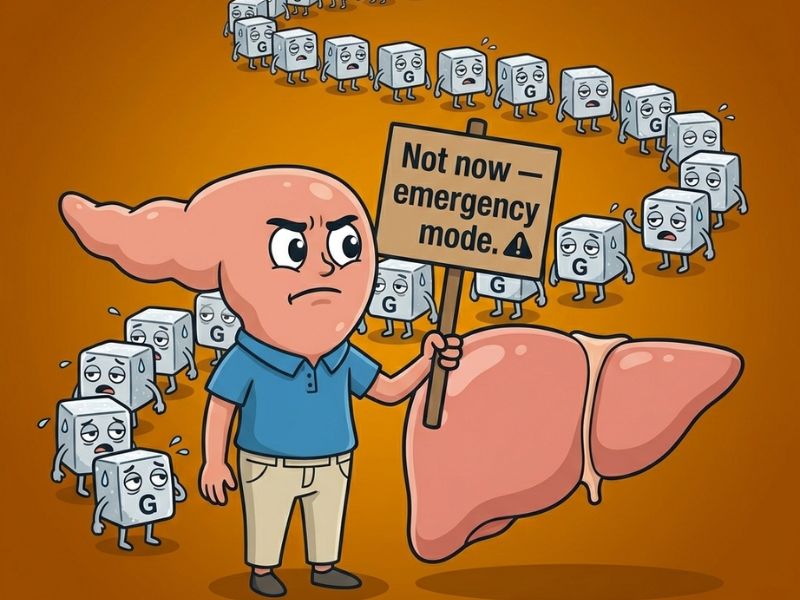
This is measurable physiology. It’s not a theory about mindfulness. It’s a well-established hormonal pathway that shows up in your readings.
How Intuitive Eating Affects Blood Sugar — The Four Eating States
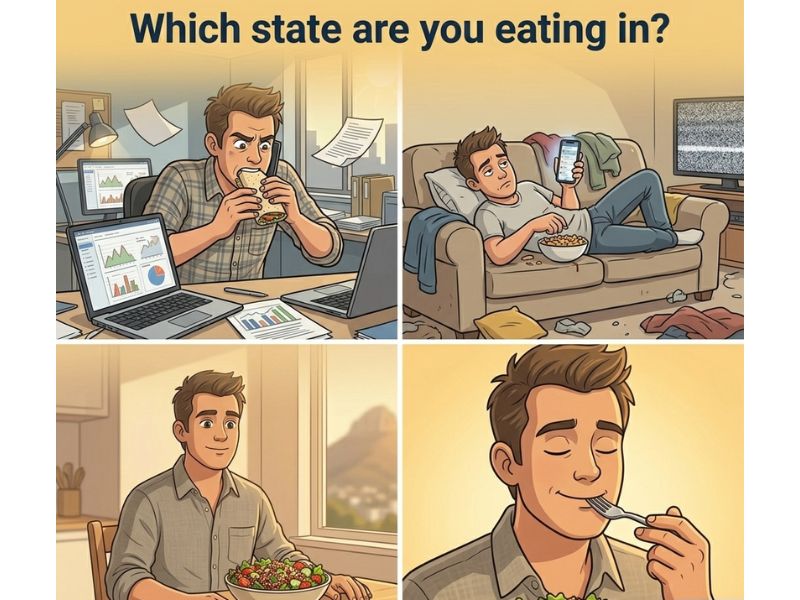
Not all eating is the same. However, most people move between four distinct states without ever noticing which one they’re in.
Stress eating happens when you eat while anxious, rushed, or overwhelmed. Your stress hormones are already elevated. Your body releases cortisol before the meal is finished. That healthy lunch produces a larger glucose response than expected — not because of what you ate, but because of the state you ate it in.
Autopilot eating is mechanical, distracted eating. You’re not particularly stressed, but you’re not present either. Phone in hand. Television on. Mind running through tomorrow’s schedule. You miss your body’s fullness signals and often eat more than you intended.
Mindful eating means eating with attention. Tasting the food. Noticing hunger and fullness. Minimal distractions. In this state, digestion works more effectively, insulin sensitivity improves, and the same foods that produced higher readings before create more stable responses.
Appreciative eating goes one step further — eating with genuine awareness of what the food is doing for your body. Your vagus nerve, which runs from your brainstem through your chest and into your abdomen, controls much of your digestive function. It operates most effectively in this calm, present state — signalling your digestive system to run at full capacity, keeping stress hormones lower, and maintaining the feedback loop that tells your brain when you’ve had enough. As a result, the meal becomes something your body can actually work with rather than manage around.
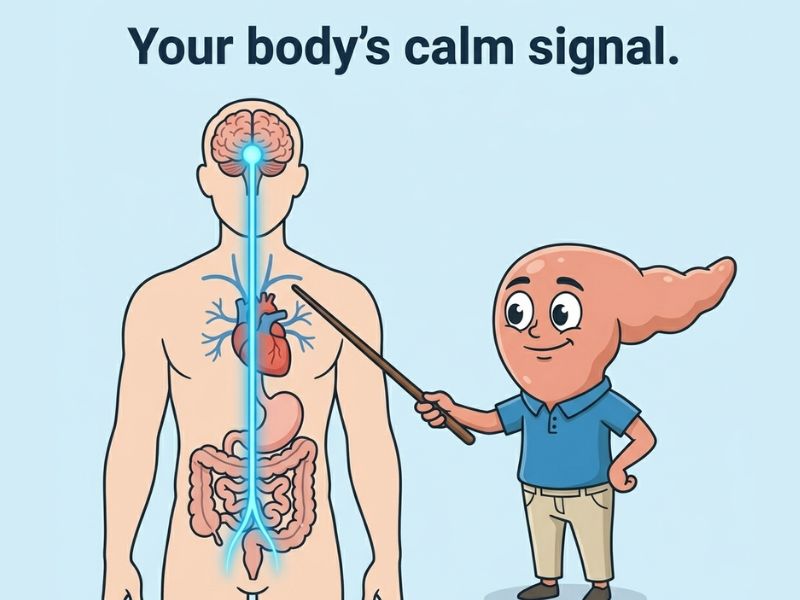
Most people with prediabetes spend the majority of their eating time in the first two states. They’re eating, but their body is only partially receiving the meal.
Why Intuitive Eating Works for Prediabetes — The Biology
The science behind this isn’t complicated, but it is consistently under-explained.
When you eat stressed, cortisol affects blood sugar directly through well-established hormonal pathways. Digestion slows. Insulin sensitivity decreases. Inflammation is triggered. The result is that your glucose reading after a meal looks worse than the food itself would suggest.
When you eat calmly, your parasympathetic nervous system — the part responsible for rest and digestion — activates and optimizes the process. Insulin sensitivity improves. Satiety signals work more effectively. Stress hormones stay lower. The same meal that caused a spike in a stressed state produces a more stable response in a calm one.
Research shows that psychological stress directly elevates postprandial glucose — the blood sugar response after eating — through well-established hormonal pathways involving cortisol and sympathetic nervous system activation that inhibits insulin secretion.
Therefore, addressing how you eat — the state you bring to the meal — is not a soft lifestyle suggestion sitting alongside the real interventions. It is one of the real interventions. For someone managing prediabetes, it belongs in the same conversation as food choices and movement.
If you want to understand the full picture of what’s driving your blood sugar — not just what you eat, but how your body processes it — I wrote a free guide that covers exactly that.
No jargon. No shame. Just the plain-language explanation your diagnosis deserved.
Intuitive Eating and Your Digestive System — What Changes When You Slow Down
When you’re calm and present, your vagus nerve signals your digestive system to operate at full capacity. Stomach acid secretion optimizes. Enzyme production increases. Gut motility — the movement of food through your digestive tract — runs at its natural pace. Your body extracts what it needs efficiently.
When you’re distracted or stressed, vagal tone decreases. Digestion slows or becomes irregular. Consequently, the feedback loop that tells you when you’re full — which depends on gut hormones signalling your brain — becomes unreliable. You keep eating past the point your body actually needed, not because of weak willpower, but because the signal never arrived clearly.
Furthermore, cortisol actively suppresses the hormones responsible for telling your brain you’ve had enough. In other words, stress eating is biologically designed to make you eat more than you need.
Your body isn’t broken when this happens.
It’s responding exactly as it was designed to respond under perceived threat conditions. Understanding that distinction — between a discipline failure and a biological pattern — is where change actually begins.
Starting Intuitive Eating With Diabetes — The Simple 3-Week System
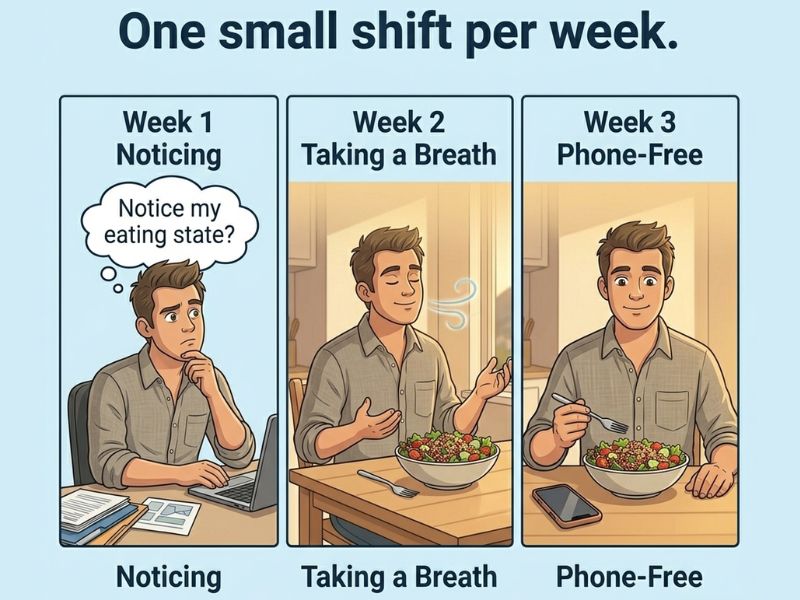
The mistake most people make is trying to change everything at once. However, sustainable change doesn’t work that way — and for someone already managing the demands of a full working week, adding a complicated eating protocol on top of everything else is a reliable path to abandonment.
This system asks for one small shift per week. Nothing more.
Week 1: Notice the Connection
Before each meal this week, pause for five seconds and ask yourself one question: how am I feeling right now — stressed, neutral, or calm?
Don’t change anything yet. Just notice. After the meal, pay attention to your energy and fullness cues. You’re building the observation habit — pattern recognition before behaviour change. You cannot shift what you cannot see.
Week 2: The 30-Second Reset
Continue noticing. Add one thing: before you eat, take 30 seconds.
Three slow breaths. Look at your food. Think: this is about to become my energy.

That’s it. Thirty seconds. But do it at every meal, consistently. What you’re doing physiologically is activating your parasympathetic nervous system before the meal begins — shifting your body from stress state toward digest state before the first bite.
In my experience as a pharmacist, most people eat distracted — phone in hand, mind elsewhere, barely tasting the food. The 30-second reset interrupts that pattern without requiring any additional time, money, or preparation.
Week 3: One Meal Per Day Without Screens
Pick one meal — any meal — and eat it without a screen. Sit down. Phone face-down. No television. Just the food.
One meal. Not every meal. This is not about perfection. It’s about introducing a single daily experience of eating with full attention, so your body begins to register what that state feels like compared to the distracted alternative.
By the end of Week 3, most people notice something they weren’t expecting — not necessarily dramatic blood sugar changes, but a quieter relationship with the meal itself. Less compulsive eating afterward. Fewer cravings an hour later. A clearer sense of when they’re actually full. That awareness is the foundation everything else builds on.
One thing worth keeping clear: calm eating complements your food choices — it doesn’t replace them. Carbohydrate load, portion size, and food quality still matter. What this system does is help your body process those choices more effectively.
What Progress Looks Like
Progress with intuitive eating for diabetes doesn’t announce itself dramatically. It shows up quietly, over weeks rather than days.
Your readings become somewhat more consistent — not perfect, but less erratic. You have more stable energy through the afternoon. Cravings when stressed start to lose some of their urgency. You make calmer food decisions even on the hard days, because you’ve built a pause between the stress and the response.
Furthermore, you start to notice your body’s signals more clearly — not because they’ve changed, but because you’ve started listening to them. Hunger feels different from boredom. Fullness arrives as information rather than surprise.
That’s not a small thing. For someone who has spent years eating on autopilot or in stress mode, learning to read your body’s actual signals is one of the most practical skills you can develop for long-term blood sugar stability.
You’re not just managing prediabetes.
You’re building a relationship with your own biology that will serve you long after the numbers normalize.

The Bottom Line
Most prediabetes advice focuses on what you eat. This blog is about what happens when you shift focus to how you eat — and why that shift produces results the meal plan alone couldn’t explain.
The same meal, eaten in two different states, can produce two different outcomes. That’s not a theory. That’s measurable physiology running through well-established hormonal pathways.
Intuitive eating for diabetes gives you a practical way to work with those pathways rather than against them. Starting with observation. Building toward presence. One meal at a time.
The 3-week system works. But doing it alone — especially when life gets in the way — is where most people drop off.
If you want a plain-speaking guide to help you make sense of what your body is doing — written by a pharmacist who has seen this pattern multiple times — start here.
Disclaimer: The information in this blog is for educational purposes only and does not constitute medical advice. Always consult your healthcare provider, who knows your full medical history, before making changes to your diet, medication, or lifestyle.
References
- Kiecolt-Glaser JK, et al. Effect of psychological stress on glucose control in patients with Type 2 diabetes. PubMed. 2011. https://pubmed.ncbi.nlm.nih.gov/21883440/
- Tracey KJ. The inflammatory reflex. Nature. 2002. https://www.nature.com/articles/nature01321
- Knowler WC, et al. Reduction in the incidence of type 2 diabetes with lifestyle intervention or metformin. New England Journal of Medicine. 2002. https://www.nejm.org/doi/full/10.1056/NEJMoa012512
- Hackett RA, Steptoe A. Type 2 diabetes mellitus and psychological stress — a modifiable risk factor. Nature Reviews Endocrinology. 2017;13(9):547-560. https://pubmed.ncbi.nlm.nih.gov/28664919/